Roof Membrane Waterproofing in Pakistan
Your roof takes the full force of Pakistani summers and monsoons. A properly installed membrane is the strongest protection it can have. Waterproofing Hawks installs torch-on bitumen, polyurethane, acrylic and single-ply roof membranes that keep ceilings dry, reduce heat and last for years on houses, plazas and factories.
- Free Inspection
- Written Warranty
- Trained Team

We find the real cause
On every project
Request a Free Quote
Share a few details and our team will contact you shortly to arrange a free inspection.
Request a Free Inspection
Most houses and buildings in Pakistan have flat reinforced concrete roofs. They are practical for water tanks, drying clothes and future extensions, but they hold water instead of shedding it like a sloped roof. Every crack, joint and weak spot in a flat roof is tested by standing water during the monsoon.
Concrete on its own is not waterproof. It is porous, and it cracks from shrinkage and from the daily heat cycle, which on a summer roof can swing by 30 degrees or more between afternoon and night. Traditional layers of mud and brick tiles, known in many places as the kacha layer or tiles over earth, slow water down but absorb it and stay wet for days, adding weight and keeping the slab damp.
A roof membrane solves these problems. It forms a continuous, flexible skin over the whole slab, turns up the parapet walls, seals around every pipe and drain, and stays watertight when the concrete beneath it moves. With a reflective top coat it also cuts the heat entering the rooms below.
Signs your roof needs a membrane
- Ceiling stains on the top floor after rain
- Water ponding on the roof for hours after a storm
- Cracked or crumbling old roof layers
- Old bitumen that has turned brittle and cracked
- Top floor rooms that are very hot in summer
- Damp at the top of exterior walls below the parapet
Roof membrane systems we install
Torch-on APP and SBS bitumen
The most popular roof membrane in Pakistan. Reinforced modified bitumen sheets, typically 3 to 4 mm thick, bonded to a primed slab with a gas torch and overlapped at seams. APP membranes handle heat well, SBS membranes stay flexible in cold weather. Finished with a reflective coat or mineral surface to protect from UV. See torch-on membrane.
Polyurethane liquid membrane
A seamless, elastic coating applied in two or more coats, ideal for roofs crowded with tanks, pipes, solar stands and level changes. Can be finished with a UV-stable aliphatic top coat in white or grey. See PU membrane.
Acrylic elastomeric membrane
A water-based, fabric-reinforced coating with high reflectivity. A cost-effective option for roofs in good structural condition and an excellent heat reducer. See acrylic membrane.
Self-adhesive membrane
For roofs where flame cannot be used, such as next to wooden structures or gas lines. See self-adhesive membrane.
Single-ply PVC, TPO and EPDM
Light, reflective sheets for large commercial and industrial roofs, mechanically fixed or bonded, with welded or taped seams. See industrial roof membranes.
Why homeowners rely on us
Honest advice, quality materials and clean work — on every single project.
Quality Service
We deliver reliable waterproofing solutions for long-lasting protection.
Skilled Team
Our team focuses on effective roof membrane waterproofing work and protection.
Quick Response
We respond promptly to your roof membrane waterproofing service inquiries.
Fair Pricing
We help customers explore suitable waterproofing options within budgets.
Leak Prevention
Our solutions help reduce water penetration and moisture damage.
Roof Protection
We help protect residential and commercial roofs from leakage.

How we install a roof membrane
1. Roof survey
We check the slab, slopes, outlets, parapets, tanks and the ceilings below to understand where water enters and how it drains.
2. Removing old layers
Wet mud, broken brick tiles and failed bitumen are removed so the membrane bonds to a sound surface and the roof load is reduced.
3. Repairs and slope correction
Cracks are filled, weak concrete repaired, and low spots corrected with screed so water flows to the outlets.
4. Fillets and outlets
Angle fillets are formed at parapet bases. Outlets are cleaned, lowered if needed and fitted with reinforcing strips.
5. Primer
A bitumen or system-specific primer seals dust and improves adhesion.
6. Membrane
Sheets are laid from the lowest point upward with 100 mm side laps and 150 mm end laps, fully bonded, and turned up parapets. Liquid membranes are applied to the specified thickness with fabric at details.
7. Flood test
Outlets are plugged and the roof is ponded to check for leaks.
8. Protection and reflective coat
A reflective coat, screed or tiles protect the membrane from UV and foot traffic.
Replacing old roof treatments with a modern membrane
Many roofs we work on have been treated several times over the decades. A typical older Lahore or Rawalpindi house might have the original slab, a mud layer with brick tiles from the 1980s, a cement screed added later to stop a leak, and one or two coats of bitumen poured on top in recent years. Each layer was meant to fix the last one, but together they add a lot of weight and trap moisture between them.
When the roof still leaks after all this, adding another layer on top is not the answer. Water is already moving between the layers, and a new coat simply seals it in. The reliable approach is to strip back to a sound base, usually the original slab or a firm screed, check and repair the concrete, correct the slope and then install a single, properly detailed membrane system.
Stripping old layers also has structural benefits. Removing a thick wet mud layer can take a significant load off an older slab, which is especially important if you plan to add another floor in future. If the slab shows rusting steel or spalling concrete once exposed, we repair it before waterproofing. See old waterproofing removal and renewal and structural concrete protection.
What Our Customers Say.
We don't just fix leaks — we build trust. Real reviews from homeowners and businesses across Pakistan, straight from our Google Business profile.
Loading reviews from Google…
Posted on Google
 Tayyaba Mughal
Trustindex verifies that the original source of the review is Google.
Bestest waterproofing services of roofPosted on Google Husnain ButtBest waterproofing services in gulbergPosted on Google
 Zoya WasimBest roof treatmentPosted on Google
 manzoor ahmadMera ghr dha 5 hy Bht Acha kam koa hawks team ny m apny friends ko or sb jannay walon ko hawks waterproofing recommend krn ga thanks hawks teamPosted on Google
 syed rameez ashfaqExcellent servicesPosted on Google
 Abdullah KungBht achi services Hn product excellent highly recommended m ny water and heat proofing ka kam krwaya fiber sheet k sath bht Acha result hy abi spa page issue b resolve ho Gia or roof b cool hyPosted on Google
 Muhammad HamzaWork they do it really worths💯 Best Quality💯Posted on Google
 HAMZA MALIKBest heat proofing m ny roof py krwai room ka temperature normal ho gia
Common roof membrane mistakes we fix
Torching over a wet roof
Moisture trapped under a torch-on membrane turns to vapour in the sun and lifts the sheet into blisters. We only torch on dry, primed surfaces.
Leaving bitumen bare
Unprotected black membranes degrade fast in Pakistani sun. A reflective coat or protection layer is essential.
Skipping the flood test
Without testing, small seam faults are only found when the ceiling stains. We test before finishing.
Ignoring the stair room and tank tops
The mumty roof and the top of concrete tanks are part of the roof and must be included in the waterproofing.
Drilling after installation
Solar panels and dish antennas fixed with bolts straight through the membrane are a common cause of new leaks. We fit sealed pads or ballasted frames.
The roof details that decide whether a membrane lasts
Open areas of a roof rarely leak once a membrane is installed. Leaks come from the details, so we give them most of our attention.
Parapet upturns
The membrane must run up the parapet wall, usually 150 to 300 mm, and be fixed and sealed at the top with a termination bar or tucked into a groove. A membrane that stops at the floor lets water run behind it.
Rain water outlets
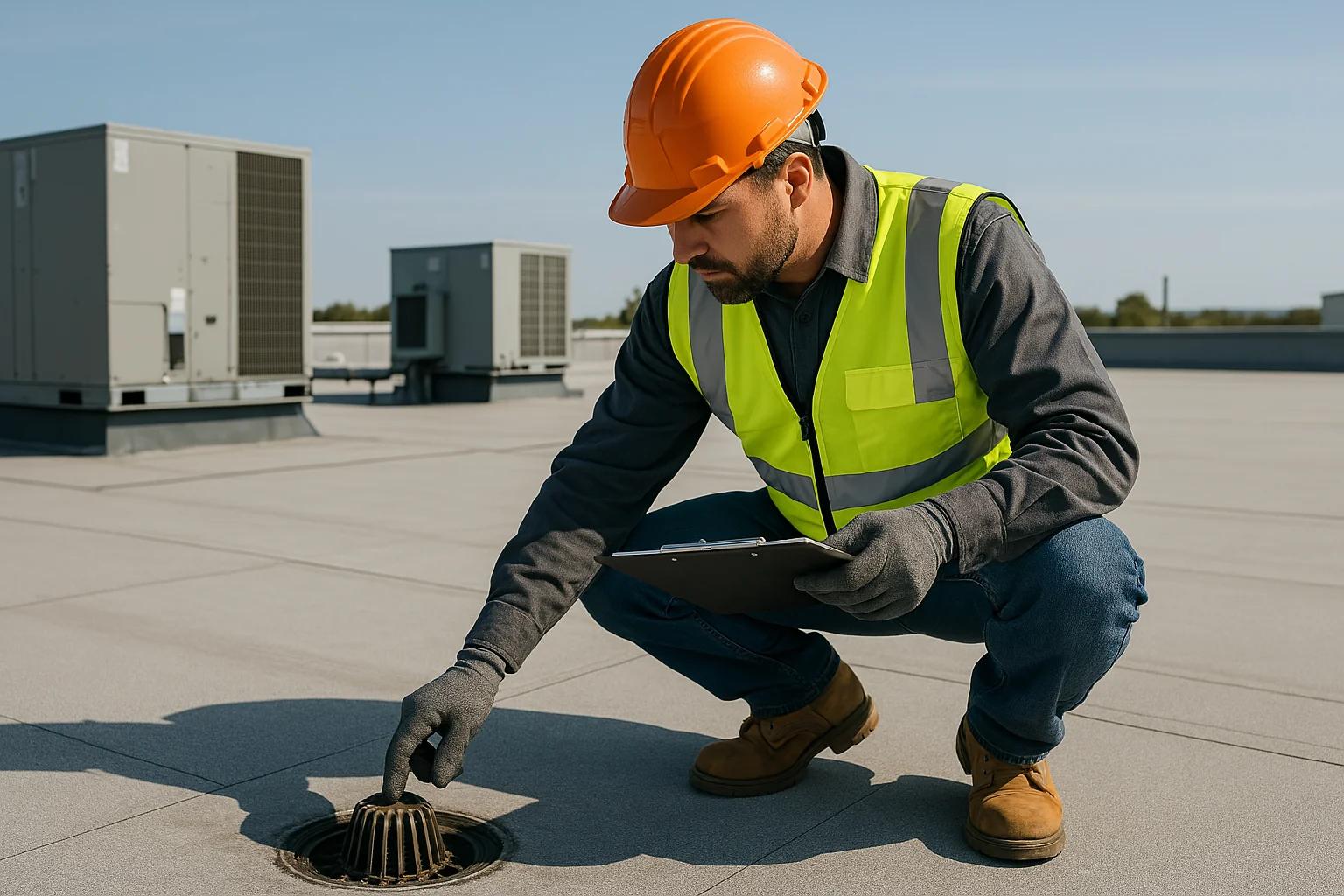
Every drop of rain passes the outlet, so it must be the best-sealed point on the roof. We lap the membrane into the outlet pipe and add a reinforcing collar.
Water tank stands
Tank bases are usually built after the roof and cut through the waterproofing. We wrap membrane around their bases or install it before the stand is built on new projects.
Pipes and solar stands
Each pipe and stand leg is sealed with a collar or liquid membrane detail.
Expansion joints
Large roofs need movement joints, which are bridged with a flexible strip so the membrane does not tear when the slab moves. See expansion joint sealing.
Stair rooms (mumty)
The roof of the stair room and the junction where it meets the main roof are frequent leak points and are treated along with the main roof.
Four simple steps to a dry home
A clear, hassle-free process from your first call to the final handover.
Get in Touch
Call, WhatsApp or fill the form and tell us about the problem.
Free Inspection
Our expert visits your site and finds the exact source of the issue.
Clear Quotation
You receive a detailed quote with materials, timeline and warranty.
Work & Handover
We complete the treatment on time and hand over your warranty.
Roof membranes and heat: keeping top floors cooler
In much of Pakistan, a roof needs to fight heat as much as water. A dark bitumen membrane left exposed can reach very high temperatures in June, which ages it faster and pushes heat into the rooms below.
We solve this with a reflective finish. A white or silver acrylic or aluminium coat over the membrane reflects much of the sun’s energy, keeps the membrane cooler and longer lasting, and reduces ceiling temperatures. For even better results we can add insulation such as PU foam or insulation boards, protected by screed. This combination is especially effective in Multan, Bahawalpur, Sukkur, Jacobabad, Dera Ghazi Khan and Faisalabad, where summer heat is most severe. See roof heatproofing and reflective membrane coating.
Roof membrane options at a glance
| System | Ideal roof | Main benefit |
|---|---|---|
| Torch-on APP/SBS | House and plaza roofs, heavy rain areas | Thick, tough, proven |
| PU liquid | Roofs with many tanks, pipes and levels | Seamless, flexible |
| Acrylic elastomeric | Sound roofs needing heat reduction | Highly reflective, lower cost |
| Self-adhesive | Flame-restricted sites | No torch needed |
| PVC / TPO / EPDM | Factories, warehouses, large roofs | Light, fast to install over big areas |
Leaking roof or a hot top floor? Let's fix it.
Book a free inspection today. Our expert will visit, find the cause and suggest the right solution.
Roof membranes for different parts of Pakistan
Punjab plains
Lahore, Faisalabad, Gujranwala, Multan and nearby cities face extreme summer heat and a heavy monsoon. Torch-on APP membranes with a reflective coat, or PU membranes with an aliphatic white top coat, are our most common choices here.
Islamabad, Rawalpindi and the north
Intense storms, hail and cold winters call for flexible membranes such as SBS bitumen or PU that stay elastic at low temperatures. In Murree, Abbottabad, Swat and Gilgit-Baltistan, snow load and freeze-thaw cycles make proper parapet upturns and outlets critical.
Karachi and coastal Sindh
Humidity and salt air attack exposed materials. UV and salt-resistant top coats, careful steel protection on old slabs and good drainage are priorities.
Interior Sindh, southern Punjab and Balochistan
Sukkur, Jacobabad, Larkana, Bahawalpur and Quetta have some of the hottest roofs in the country. Highly reflective membranes combined with insulation give the biggest benefit, lowering both leaks and cooling costs.
Roof membrane cost factors

Cost depends on roof area including parapet upturns, the system selected, how much old material must be removed, the amount of crack repair and slope correction, the number of tanks, pipes and details, the protection or reflective layer and access to the roof. After a free survey we give a written quote showing each of these items, the membrane thickness or layers, and the warranty period, so you can compare options clearly.
- Trained applicators for torch-on, liquid and single-ply systems
- Old roof layer removal and slope correction included where needed
- Careful detailing at parapets, outlets, tanks and pipes
- Flood testing before protection
- Reflective finishes for cooler rooms
- Written quote and warranty
Call or WhatsApp 0321-4156036 or book a free roof survey.
Related services you may need
Water and heat problems rarely come alone. These related services are often done together with roof membrane waterproofing.
Questions about Roof Membrane Waterproofing
Answers to the questions customers ask us most about roof membrane waterproofing.
0321-4156036
Is torch-on or PU better for my roof?
Torch-on suits simple flat roofs and heavy rain areas. PU suits roofs with many tanks, pipes and corners. Many roofs use both. We recommend after a survey.
Do I need to remove the old mud and brick tiles?
Usually yes. They hold water, add weight and stop the membrane bonding to the slab.
How long does a roof membrane last?
A well-installed, protected membrane lasts many years. Exposed systems need their top coat refreshed periodically. Your quote states the expected life and warranty.
Can the membrane be installed in summer?
Yes. Summer is ideal because surfaces are dry. We avoid the hottest hours for some systems and avoid rainy days entirely.
Will the roof be usable afterwards?
Yes. Light foot traffic is fine on most systems, and we add tiles or a traffic coat for roofs used as terraces.
Does a roof membrane reduce heat?
With a reflective top coat, yes, noticeably. Adding insulation reduces it further.
How long does installation take?
Most house roofs take two to five days including preparation and flood testing.
Do you give a warranty?
Yes, a written warranty is included with complete roof membrane systems.
Can you install a membrane under solar panels?
Yes. Ideally the membrane goes in before the panels. For existing panels we can work around them and seal each stand leg properly.
What is the best time of year to install a roof membrane?
March to June is ideal across most of Pakistan, because roofs are dry and you are protected before the monsoon. October and November also work well.
Can a roof membrane be repaired if it gets damaged?
Yes. Punctures, open seams and blisters can be patched with compatible material. We also offer yearly inspections to catch damage early.
Latest tips & guides
Practical advice to help you protect your home from leakage and heat.